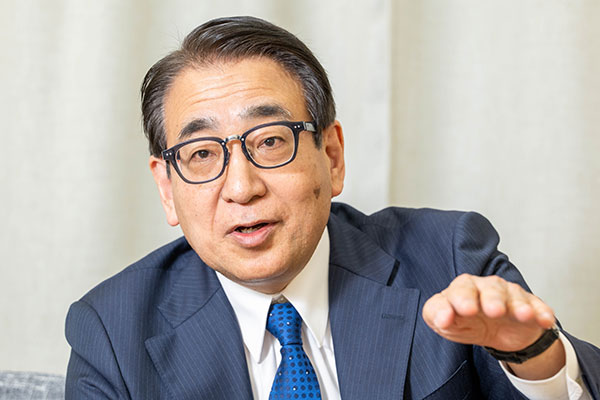
- Masahiko Shimoda
- Advisor, Sanwa Shurui Co., Ltd. / Doctor of Engineering
Born in 1955 in Bungo-Ono City, Oita Prefecture. After graduating from the Department of Fermentation Technology, School of Engineering, Osaka University, he worked for a sake brewery in Hyogo Prefecture. In 1984, he returned to Oita and joined Sanwa Shurui. While engaged as a technical specialist in shochu production technology development, product development, and quality control, he earned his Doctor of Engineering degree from Osaka University in 1998. Appointed to the Board of Directors in 1999, he became the company’s first president from outside the founding family in 2017, and was appointed Chairman in 2023. He has served as Advisor since October 2025.
Insights
Dr. Shimoda’s New Theory of Honkaku Shochu – Vol. 6
How Honkaku Shochu Is Made: “Second Moto, Third Brewing” (Part 2-2) — Achieving High Alcohol Concentration through Multiple Parallel Fermentation
This series presents firsthand insights from Masahiko Shimoda—affectionately known as “Dr. Shochu”—who has been involved in the production of honkaku shochu at Sanwa Shurui as both an engineer and as an executive. In this installment, we introduce multiple parallel fermentation, a uniquely Japanese fermentation technique also shared with sake brewing, as it occurs in the primary and secondary fermentation stages of honkaku shochu production.
⇒ Vol. 5: “Second Moto, Third Brewing” Part 2-1 — The Source of Honkaku Shochu’s Diversity
As told by: Masahiko Shimoda, Advisor, Sanwa Shurui Co., Ltd. / Composition: Kenji Inoue, Contentsbrain
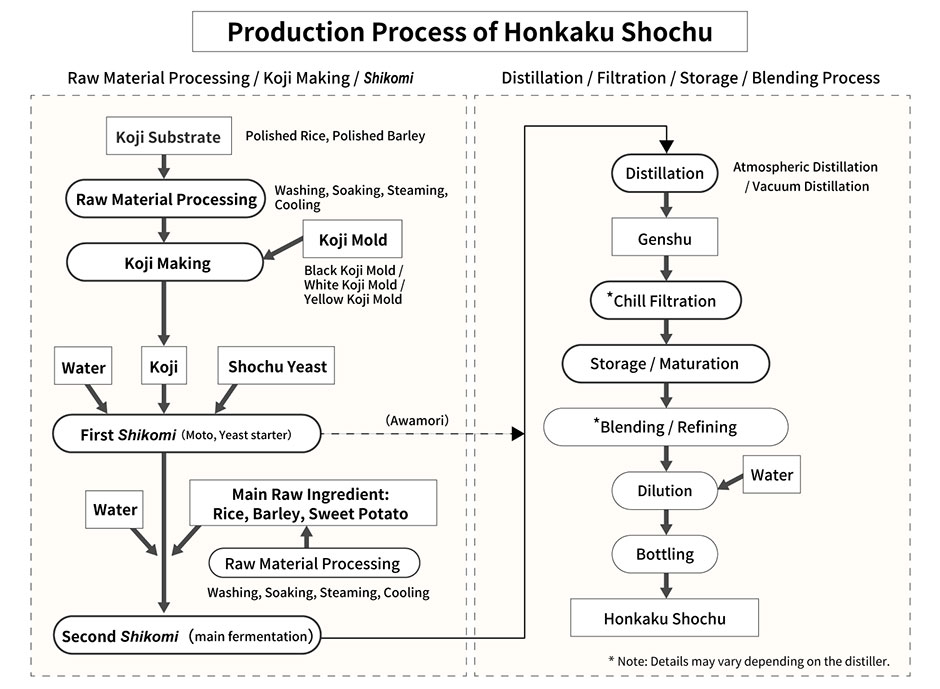
So far, we have explained the first half of the honkaku shochu production process. This involves preparing the ingredients, making koji by adding koji mold to steamed rice or barley, and then mixing it with water, yeast, and a main ingredient such as barley or sweet potatoes for fermentation to produce alcohol.
In the fermentation process for sake and honkaku shochu, both of which use koji mold, alcohol is produced through a distinctive fermentation method known as multiple parallel fermentation, unlike with other alcoholic beverages such as wine, beer, whisky, and brandy. This time, I would like to discuss the multiple parallel fermentation that occurs in barley shochu moromi,⋆1 and how it relates to the sake brewing principle of “first koji, second moto, third brewing” that we have discussed so far.
⋆1 Moromi: A state in which koji, water, yeast, and other ingredients have been added to a fermentation tank and are then fermenting.
How Fermentation Method Affects Alcohol Concentration
In Japanese alcohol production, koji is first made by adding koji mold to rice or barley. The resulting rice koji or barley koji is then placed in a single tank with water and the main ingredient, such as steamed rice, barley, or sweet potatoes, and fermented. This is called “multiple parallel fermentation” because the saccharification process, in which the various enzymes in koji convert the starch in the main ingredient into sugars, and the fermentation process, in which yeast converts those sugars into alcohol, occur simultaneously.
The final alcohol concentration of moromi produced through multiple parallel fermentation reaches 17–20%. The fermentation method used for wine is called “simple fermentation,”⋆2 and produces an alcohol concentration of 11–14%. Beer uses “multiple sequential fermentation,”⋆3 which produces an alcohol concentration of 4–6%.
⋆2 Simple fermentation in wine: A fermentation method in which yeast consumes glucose contained in grapes or other ingredients and converts it into alcohol.
⋆3 Multiple sequential fermentation in beer: A fermentation method in which saccharifying enzymes contained in malt saccharify the starch in barley, and yeast then consumes the resulting sugars and converts them into alcohol.
In alcoholic fermentation, alcohol equivalent to around half the sugar content of the ingredients, or 0.55 times that amount, is obtained. This coefficient of 0.55 is an empirical rule: for example, grape juice with a sugar content of 24% can be expected to produce wine with an alcohol concentration of around 13.2%, calculated by multiplying by 0.55. Sake and honkaku shochu produce moromi with a final alcohol content of 17–20%, but producing this level of alcohol would require a sugar solution (a liquid containing sugar) with a concentration of 30–36%.
However, it is impossible to produce such a highly concentrated sugar solution through ordinary saccharification. Even if the solution were concentrated to raise the sugar content, osmotic stress would occur, suppressing microbial activity as in sugar preservation, and the yeast would also be unable to proliferate. For this reason, it is impossible to achieve an alcohol content of 20% through simple fermentation or multiple sequential fermentation.
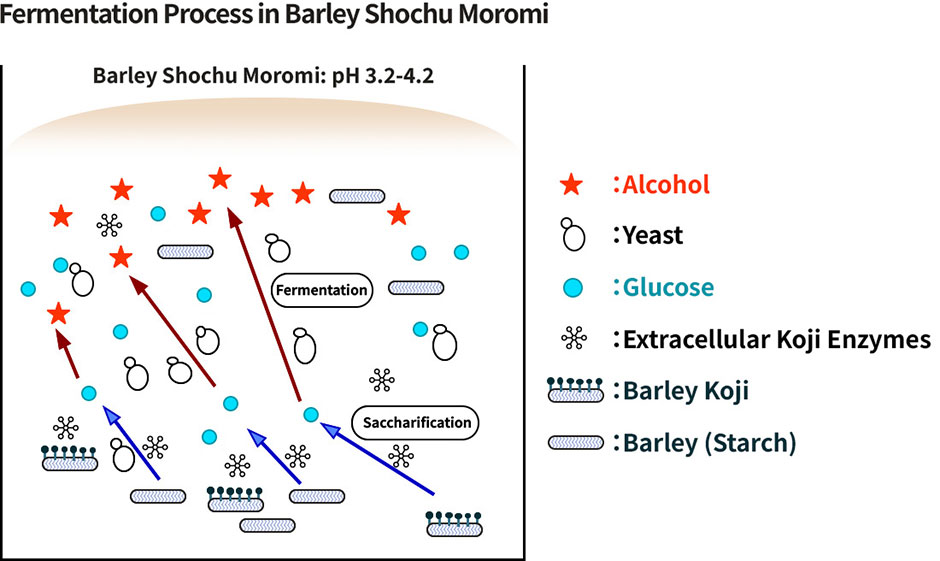
Multiple parallel fermentation is what makes this impossible feat possible. Please refer to the diagram above, “Fermentation Process in Barley Shochu Moromi.” First, enzymes released from the koji break down the starch into sugars such as glucose. As sugar accumulates in the moromi, the yeast is ready and waiting to take it in, metabolizing it to produce alcohol and carbon dioxide.
If there is too little yeast, or if its activity is weak, the sugar will not be consumed, causing the sugar concentration in the moromi to rise and fermentation to stop. Conversely, if yeast activity outpaces sugar production, the sugar in the moromi will be depleted, again bringing fermentation to a halt.
The most important thing is to make the koji properly, ensuring there are enough various enzymes to dissolve the koji and main ingredient during preparation, breaking them down into sugars. This is “first koji.” The second most important thing is to secure enough vigorous yeast to ferment those sugars. This is “second moto.” Once these two have been properly achieved, the skill of the person guiding the subsequent multiple parallel fermentation becomes important. This is “third brewing.”
Only when these three elements are in place can the ingredients be fully converted into alcohol and the alcohol content raised to around 20%. It is remarkable how much sense this maxim, born from the experience of the toji (master brewers) of the past, makes.
⇒ Vol. 5: “Second Moto, Third Brewing” Part 2-1 — The Source of Honkaku Shochu’s Diversity
Main references: Honkaku Shochu Seizo Gijutsu (Honkaku Shochu Production Technology, Brewing Society of Japan, 1991); Sake-zukuri no Hanashi (Stories of Sake Brewing) by Yuichi Akiyama (Gihodo Shuppan, 1983); Hakko to Jozo II (Fermentation and Brewing II), edited by Kazuo Azuma (Korin Publishing, 2003); Sekai no Spirits: Shochu (Shochu: Spirits of the World) by Akira Sekine (Gihodo Shuppan, 2005); Shochu no Rirekisho (The Resume of Shochu) by Yoshihiro Sameshima (Ikaros Publications, 2020).