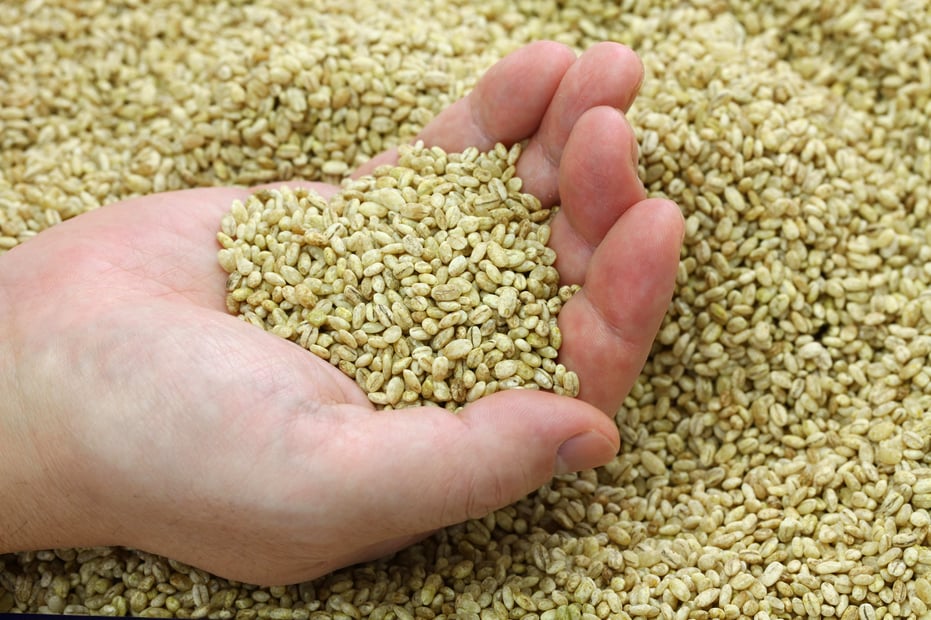
In the second part of Dr. Koizumi’s commentary, we turn to koji mold (also known as koji fungus)—the key player in making koji. While commonly referred to as a single group, koji mold actually includes several varieties, such as yellow, black, and white strains, each with its own unique characteristics used in making miso, soy sauce, sake, honkaku shochu (single-distillation shochu), awamori, and more. Dr. Koizumi also shares the origin of the Chinese character for “koji” as it’s used in Japan.
⇒Read Part 1: “Fermentation Benefits Us, While Rotting Does Not”
Expert Commentator: Takeo Koizumi, Professor Emeritus, Tokyo University of Agriculture
Interview & text: Chieko Fujita / Photography: Koichi Mitsui / Composition: Contentsbrain / English Translation: LIBER
Fermented Foods May Help Boost the Immune System
One area of particular interest to me within the world of fermentation is how strongly fermented foods may support the immune system. The health benefits of fermented foods have been widely discussed, and data has emerged suggesting they can help enhance human immunity. Take amazake, for example—a sweet fermented beverage made from rice and rice koji. It’s so rich in nutrients that it’s often called “a drinkable intravenous drip.” Even in the medical field, some doctors have begun to show interest in amazake, and there are people who want to study the connection between fermented foods and immune function.
Fermented foods outside Japan also offer notable health benefits. For example, kimchi, a fermented food from Korea, is said to have a very high immune-boosting effect. In Southeast Asia—countries like Vietnam, Laos, Cambodia, Thailand, and Myanmar—people regularly consume fermented foods that are known to support immunity. What’s particularly fascinating is the difference in fermentation molds by region. In Southeast Asia, Korea, and China, the dominant mold species is Rhizopus, commonly known as kumonosukabi⋆1(literally “cobweb mold”). In contrast, koji mold (Aspergillus) is found only in Japan.
⋆1 Kumonosukabi: A mold of the genus Rhizopus, commonly found in China and Southeast Asia. It forms long hyphae over 1 cm in length, with black, spherical spores at their tips. In contrast, the yellow, black, white, and soy sauce-specific strains of koji mold—all belonging to the genus Aspergillus—are unique to Japan.
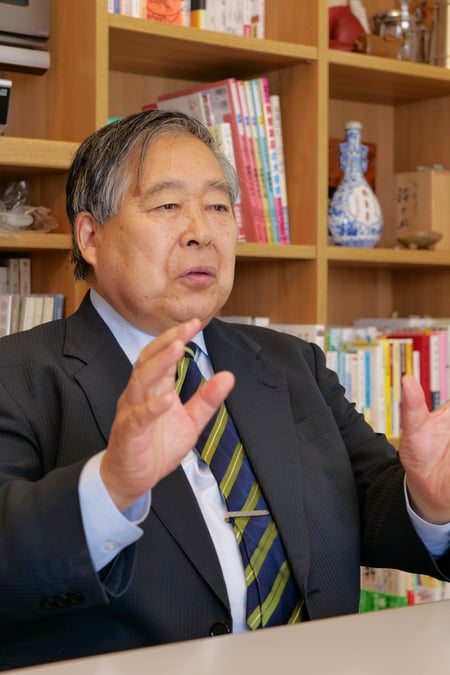
Takeo Koizumi, Professor Emeritus at Tokyo University of Agriculture
Yellow, Black, and White Koji Mold of the Aspergillus Genus
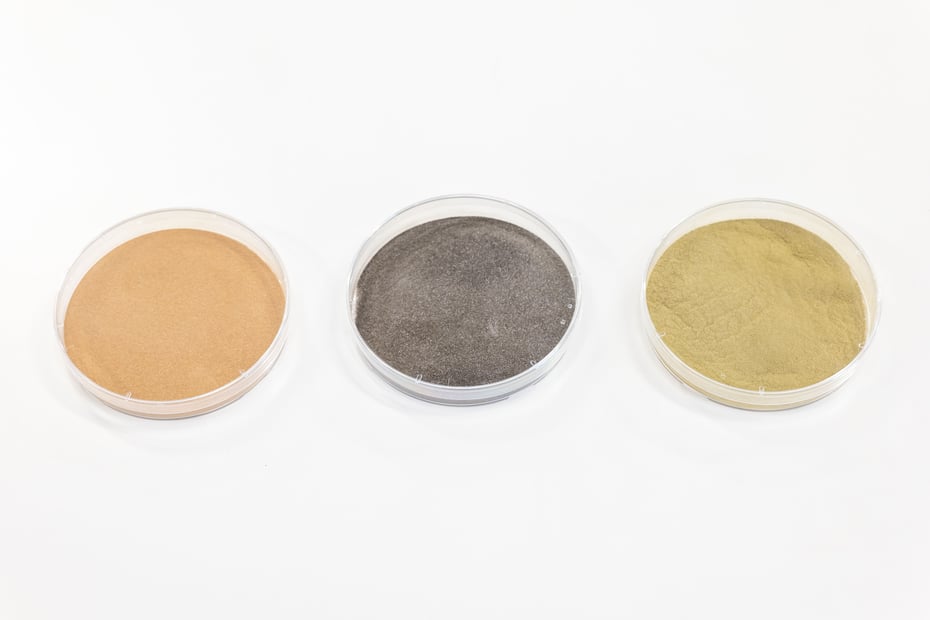
In Japan, koji mold has been officially designated as the national fungus. Many countries have a national flower or a national bird, but Japan is the only country to have a national fungus. There are three main types of koji mold. The first is yellow koji mold, used to make miso, soy sauce, mirin, sake, rice vinegar, amazake, and more. Its scientific name is Aspergillus oryzae. Oryzae comes from the Latin word for rice—it refers to mold that grows on rice.
The second type is black koji mold, which is mainly used in the production of shochu and awamori. Black koji mold naturally occurs only in Okinawa, which led the International Union of Microbiological Societies to name it Aspergillus luchuensis (“luchuensis” refers to Ryukyu, the former name of Okinawa). This mold is known for producing large amounts of citric acid, which helps prevent contamination from unwanted microbes during the fermentation process.
White koji mold is a white mutation of black koji mold. Its scientific name is Aspergillus luchuensis mut. kawachii. It is primarily used in the production of shochu. Like black koji mold, it produces large amounts of citric acid, but it also has the added advantage of being less likely to stain clothing or equipment during production.
(Editor’s note: Sanwa Shurui uses this white koji mold in the production of its barley-based honkaku shochu.)
Much of Japan’s food and sake culture owes its richness to the blessings of koji mold. When you think about it that way, koji mold is truly something to be thankful for. The origin of the word koji is also quite fascinating. In the Harima no Kuni Fudoki⋆2 —a regional report compiled around the year 713—there’s a passage that says steamed rice was offered to the gods, and mold began to grow on it. This phenomenon was referred to as kabidachi (literally, “mold forming”). Over time, the word evolved: kabidachi → kamutachi → kamuchi → kauchi → and eventually became koji as we say today. In other words, the old Japanese word for koji was kabidachi, meaning “the forming of mold.”
⋆2 Harima no Kuni Fudoki: One of the “Fudoki,” a series of reports compiled in the 8th century during Japan’s Nara period, documenting local culture, climate, and products for the emperor. Harima no Kuni refers to the area that is now part of Hyōgo Prefecture.
The Origins of the Characters「麹」and「糀」for Koji
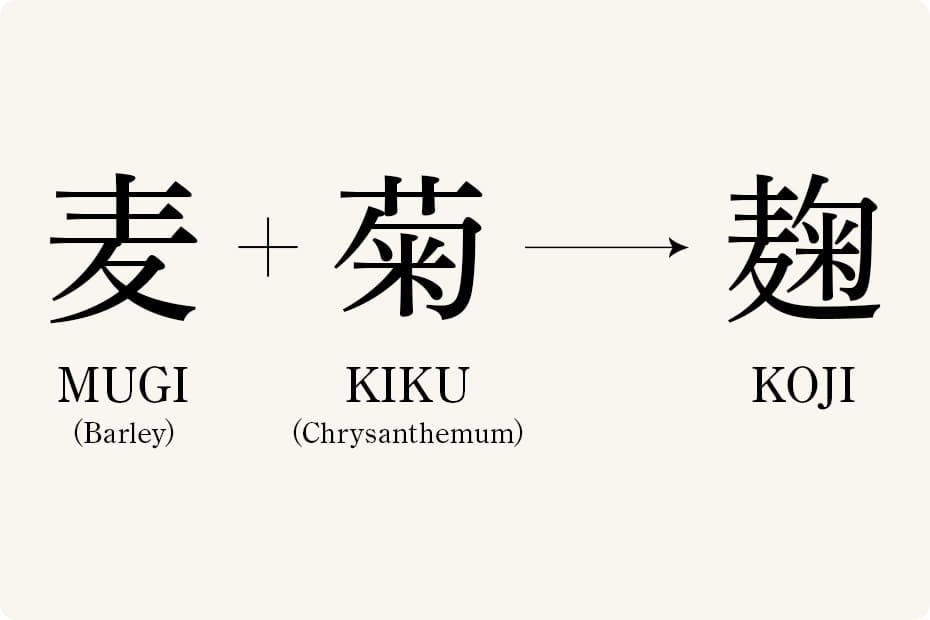
Let’s take a moment to look at the origins of the character「麹」(koji). It’s made up of two parts: on the left is the character for “barley” (麦), and on the right is the character for “chrysanthemum” (菊). This character for koji is quite old and was brought to Japan from China.
On the other hand, there’s also the character「糀」(koji), which combines the character for “rice” (米) on the left with the character for “flower” (花) on the right. This is a kokuji—a character created in Japan. It’s as if flowers are blooming on the surface of the rice—quite fitting, don’t you think?
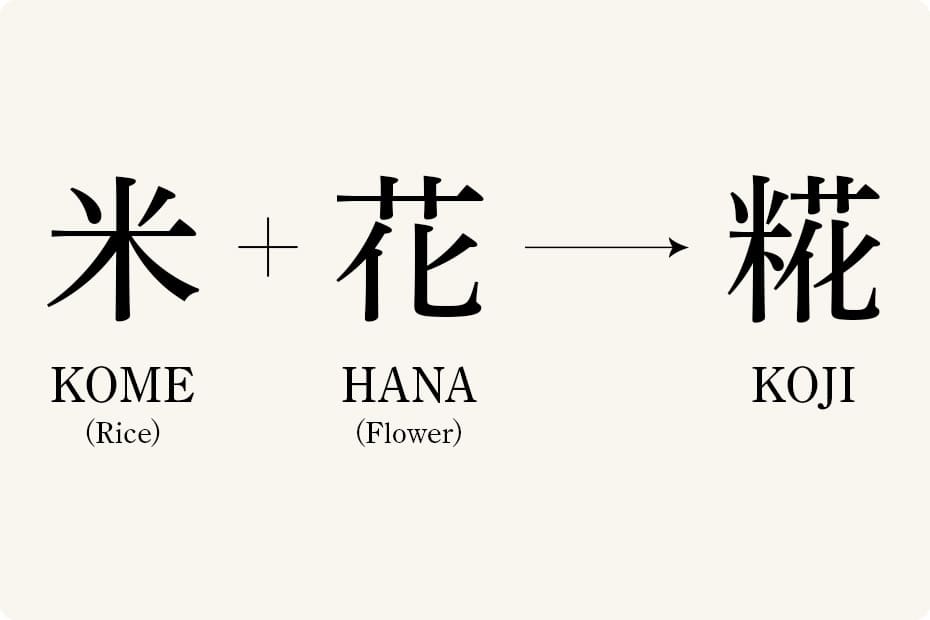
If we define what koji is, it refers to a state in which mold has propagated on grains. That’s why you’ll also find koji in places close to Japan with similar climates, such as Taiwan, China, Korea, and countries in Southeast Asia. However, only in Japan do we see the unique practice of using rice koji—rice with koji mold cultivated on it—or barley koji, in which koji mold is cultivated on barley, to brew alcoholic beverages in a way that has no equivalent abroad.
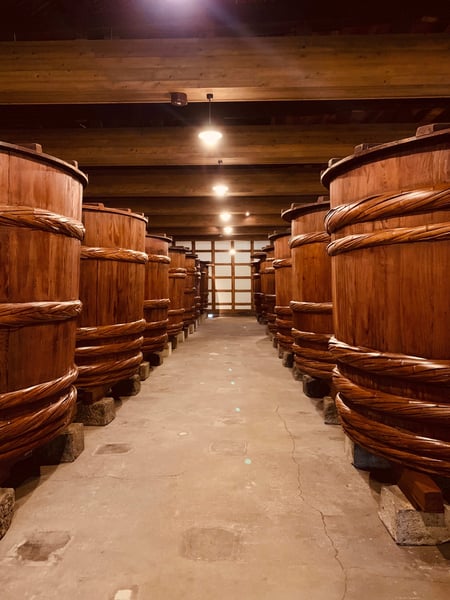
I served as chair of the initiative to have Japan’s traditional brewing techniques—which use koji mold to produce shochu, sake, awamori, and mirin—recognized as a UNESCO Intangible Cultural Heritage. That effort bore fruit, and in December 2024, “Traditional Knowledge and Skills of Sake-making with Koji Mold in Japan” were officially inscribed on the UNESCO Intangible Cultural Heritage list. I hope this will continue to energize the sake and spirits industry moving forward.
⇒Read Part 1: “Fermentation Benefits Us, While Rotting Does Not”
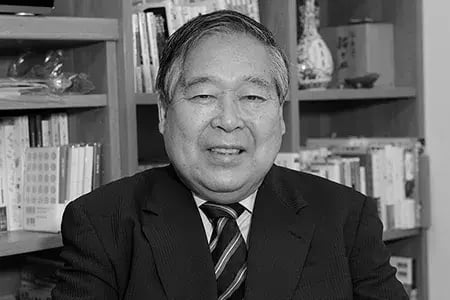
Takeo Koizumi
